


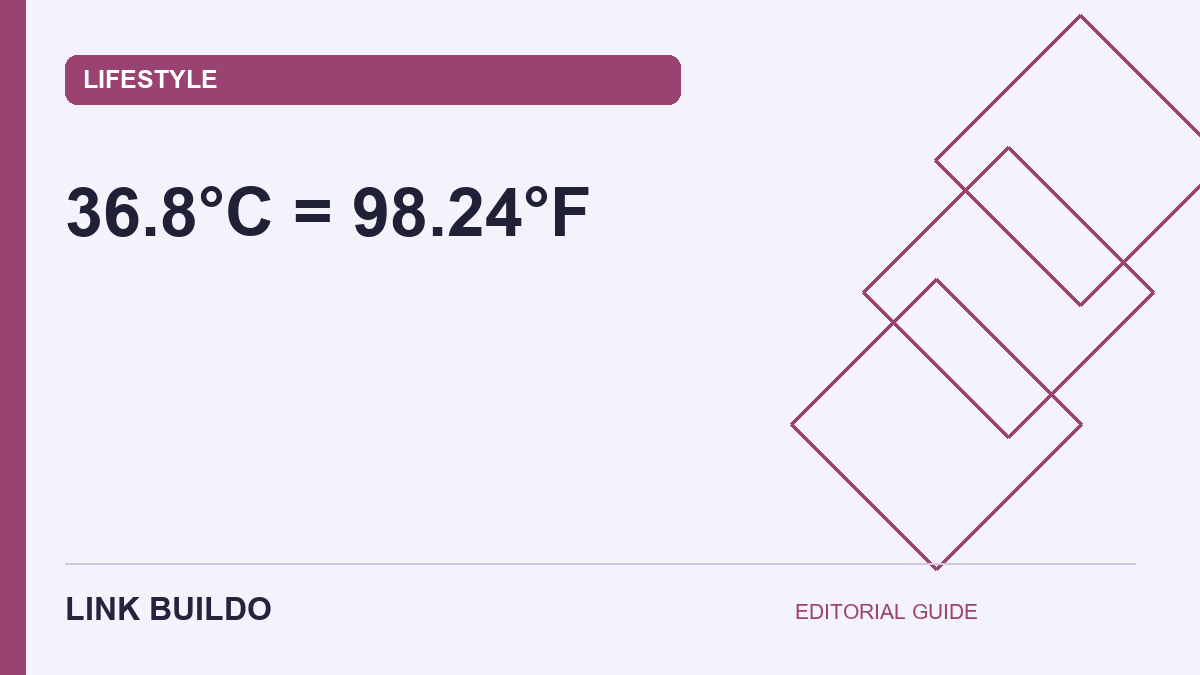
36.8°C equals 98.24°F, or 98.2°F rounded to one decimal place. This is a unit conversion; it is not a diagnosis or a guarantee that someone is well.
Corrected 25 October 2026: Removed unsupported personal stories, blanket health reassurance and an inaccurate shortcut suggested for thermometer readings.
The exact calculation
Use °F = (°C × 9 ÷ 5) + 32.
- Multiply 36.8 by 9: 331.2.
- Divide by 5: 66.24.
- Add 32: 98.24°F.
Multiplying by 1.8 instead of multiplying by 9 and dividing by 5 gives the same result. To reverse the conversion, subtract 32 from Fahrenheit and multiply by 5/9.
Nearby conversions
| Celsius | Fahrenheit |
|---|---|
| 36.5°C | 97.7°F |
| 36.8°C | 98.24°F |
| 37°C | 98.6°F |
| 37.5°C | 99.5°F |
| 38°C | 100.4°F |
A table converts the displayed number only. It does not correct an inaccurate measurement or account for different thermometer methods.
Why rounding matters
Reporting 98.24°F gives the exact mathematical result for 36.8°C. It does not mean the thermometer itself measures to that precision. If you are recording a reading for a clinician, keep the original number, unit, time and measurement method rather than converting and rounding repeatedly.
The shortcut “double Celsius and add 30” gives 103.6°F here, an error of 5.36°F. Do not use that approximation for a body-temperature reading.
Does 36.8°C mean there is no illness?
No. The NHS adult fever guidance says normal body temperature differs between people and changes during the day. A high temperature is usually 38°C or above, but someone feeling hot, cold or shivery may have a high temperature even with a reading below 38°C. Follow the thermometer instructions and consider symptoms rather than using one number as reassurance.
The same NHS page advises an urgent GP appointment or NHS 111 when a high temperature being treated at home is worsening or not improving. It links separate guidance for children and babies; adult thresholds should not be used as a complete assessment of a child.
A useful record
Write “36.8°C, measured at [time] using [method]” alongside relevant symptoms. That preserves the original information. If you are worried about how someone is feeling, seek appropriate medical advice rather than relying on this conversion page.
For another worked unit conversion, see 183 cm in feet and inches. It shows how exact conversion factors and rounded display values differ; it does not interpret a medical measurement.

